Why AI Doesn’t Know Your Business — and Why RAG Matters
Even a powerful AI model does not know your company’s internal processes, documents, or rules. Here is why AI quickly hits a ceiling without corporate data — and how RAG solves that problem.
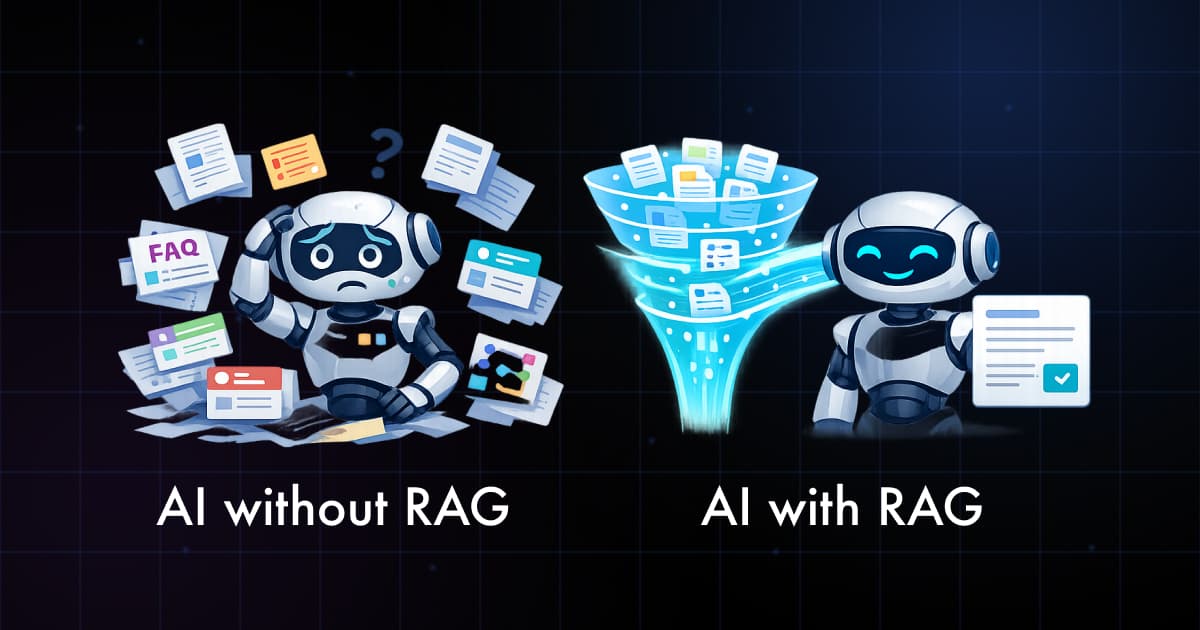
AI can write, explain, analyze, and hold conversations. So businesses quickly arrive at a natural idea: if the model is this capable, why not embed it into real company workflows — support, sales, onboarding, internal knowledge search, and document handling?
In practice, this is exactly where the main disappointment often appears. AI may be smart, but that does not automatically make it useful for your business. It knows the world in general, but it does not know your company: its documents, rules, limitations, processes, and context.
That is where RAG comes in. Its purpose is not to make AI “even smarter,” but to connect the model’s capabilities with your business’s actual knowledge.
TL;DR
- AI knows general things, but it does not know how your company works internally.
- Without access to corporate data, its answers are too generic.
- RAG helps AI find relevant information in company knowledge and use it in its response.
- This is especially useful in support, sales, onboarding, and internal search.
- But RAG is not always necessary: if the task does not depend on internal knowledge, it may be unnecessary overhead.
Why AI often falls short in business
First impressions of AI are usually very strong. A model can quickly formulate ideas, help with writing, structure information, answer questions, and suggest approaches. After that, the next step seems obvious: connect AI to real work tasks and get the same effect inside the company.
But there is a fundamental difference between a “smart model” and a “working business tool.”
In everyday use, AI performs well when general context is enough: explaining a topic, proposing a structure, preparing a draft, or comparing approaches. In business, however, you often need something else — not just a reasonable answer, but an answer that reflects how things actually work inside your company.
What terms apply to a customer? What limitations does the product have? What sequence of actions is defined in the internal process? What wording is acceptable — and what wording is not?
If AI does not know these things, it answers from generic logic rather than from company context. Sometimes that sounds convincing. But for real work, it is not enough.
AI knows a lot — but not your company
This is the core limitation that companies often underestimate.
A modern model can confidently explain how support is typically organized, what a standard onboarding process looks like, what belongs in an FAQ, or how internal knowledge bases are usually structured. But all of that is knowledge “about the world,” not knowledge “about you.”
Business needs the second kind of knowledge:
- internal instructions;
- product documentation;
- policies and rules;
- knowledge bases;
- historical case examples;
- data from CRM, helpdesk, and other systems.
Without that context, AI remains a general-purpose assistant. It may still be useful for broad tasks, but in real business workflows it quickly hits a ceiling. Answers become too generic, not precise enough, or simply disconnected from how the company actually operates.
The problem is not the quality of the model. The problem is that it does not have access to the right knowledge at the time of the request.
What AI needs to be useful for business
For AI to be not just “generally smart” but genuinely useful, it needs access to the knowledge that supports your company’s day-to-day operations.
That may include:
- an internal knowledge base;
- instructions and policies;
- product documentation;
- support responses;
- sales materials;
- data from internal systems.
These are the sources that determine whether AI can produce an answer that is actually useful in real work. Not “how companies usually do it,” but “how it should be done here.”
In business, AI’s usefulness depends not only on the model itself, but also on whether it can rely on the company’s internal context.
Why it is not enough to just “give AI documents”
This is where a naive expectation often appears: if the problem is missing knowledge, then uploading documents should solve it.
Usually, it does not.
First, company knowledge is almost always spread across multiple systems: folders, knowledge bases, Notion, CRM, help centers, spreadsheets, and internal documents. Second, any given question rarely needs the entire body of information — only the part that is actually relevant. If you pass everything to the model at once, the answer does not get better. The noise just increases.
AI does not need your entire company archive. It needs the right fragment of data at the right moment.
And that is exactly the problem RAG is designed to solve.
What RAG is — without the textbook tone
RAG (Retrieval-Augmented Generation) is an approach where AI first finds relevant information in company data and then uses it as context before generating a response.
Put simply, the model does not try to answer using only its general knowledge. It first retrieves the necessary data — from a knowledge base, documentation, internal instructions, or business systems — and only then forms an answer.
For business, this is the key point: AI begins to rely not on a generic idea of “how things usually work,” but on the real knowledge of a specific company.
How RAG works in practice
The logic is fairly simple:
- A user asks a question.
- The system searches company sources for relevant information.
- The retrieved context is passed to the model.
- The model generates a response based on that data.
RAG does not retrain the model from scratch or turn it into a permanent “carrier of all company knowledge.” It solves a more practical problem: giving AI the right information at the right time.
That is exactly why RAG is especially useful in scenarios where answers must rely on internal knowledge rather than just the model’s general understanding.
Where RAG is genuinely useful for business
RAG works especially well in scenarios where the main value comes from fast access to company knowledge.
Internal assistant for employees
When employees need to quickly understand a rule, find an instruction, check a process, or clarify the correct next step.
Customer support
When answers depend on the help center, product documentation, internal guidelines, and company policies.
Sales and account management
When managers need quick access to case studies, product limitations, response templates, and standard objections.
New employee onboarding
When instead of handing over a pile of links and folders, the company wants to provide an easy way to get answers about internal rules and processes.
Working with corporate knowledge
When there are too many documents to navigate comfortably, and searching through them takes too much time.
In all of these cases, RAG is not valuable for the sake of the technology itself. It is valuable because without access to corporate knowledge, AI remains too generic.
Why data often matters more than the “most powerful model”
It is easy to get caught up in choosing a model: which one is stronger, which one reasons better, which one is more advanced. But in real business scenarios, that is often not the main question.
The main question is: what knowledge does the system actually work with?
Even a very powerful model without access to internal data will still answer too broadly. On the other hand, a less “hyped” model with strong access to company knowledge may be far more useful in everyday work.
For business, the practical value of AI is often defined not by how impressively it reasons, but by how well it is embedded in the company’s context.
When RAG is needed — and when it is not
Not every AI project needs RAG.
It is especially justified when:
- the answer depends on internal company knowledge;
- the information changes frequently;
- accuracy and traceability to sources matter;
- knowledge is stored across several systems and is inconvenient to use manually.
But if the task is simply text generation, idea generation, summarization, or work with public information, ordinary AI may be enough. In some cases, a direct integration with the required system or standard automation works even better than RAG.
RAG is not a mandatory universal layer. It is needed when the main value depends on company knowledge.
Important limitations to understand upfront
RAG does not automatically fix chaotic data.
If the knowledge base is outdated, documents contradict each other, or information is poorly structured, that will affect AI responses as well. If the company has no clear source of truth, the technology will not create one on its own.
There are also practical questions that still remain:
- which sources should be connected;
- how to control access to sensitive data;
- how to evaluate response quality;
- where a human should stay in the loop;
- how to keep knowledge up to date.
So RAG is not magic — it is a tool. It increases the usefulness of AI, but it does not eliminate the need for high-quality data and well-organized knowledge.
Conclusion
AI does not know your business on its own. It cannot see your internal documents, understand your company’s processes, or know which rules apply in your organization. That is why, without access to corporate knowledge, it often remains just a smart interface — convenient, but too generic for real work.
RAG exists to connect the model’s capabilities with real business data. It does not make AI all-knowing. But it is often what turns AI from an impressive demo into a tool that truly helps a company work faster and more accurately.
Frequently asked questions
What is RAG in simple terms?
It is an approach where AI first finds the relevant information in company sources and then uses it as context before answering.
Why doesn’t AI know my business on its own?
Because the model does not have built-in access to your internal documents, policies, knowledge base, CRM, or other corporate data.
How is RAG different from a regular AI chat?
A regular AI chat mainly answers based on the model’s general knowledge. RAG adds access to company-specific data.
Why does a business need RAG?
So AI can answer based on the company’s actual knowledge, not just general patterns.
What tasks benefit most from RAG?
Internal knowledge search, customer support, employee onboarding, sales enablement, and working with corporate documentation.
Does every AI agent need RAG?
No. It is only needed when the agent must work with a company’s internal knowledge.
Can RAG replace proper data management inside a company?
No. If your knowledge is outdated or poorly organized, RAG will not fix that by itself.
What matters more: a powerful model or access to data?
In many practical business scenarios, access to the right data matters more than choosing the most powerful model.