Enterprise System Development for Private LTE Network Management
TelecomA frontend development case study of a telecom web application for operators and system integrators: infrastructure monitoring, incident management, topology visualization, and command operations in a high-load SPA.
About the Project
Enterprise Systems / Telecom • Web Application • Network Infrastructure Management System
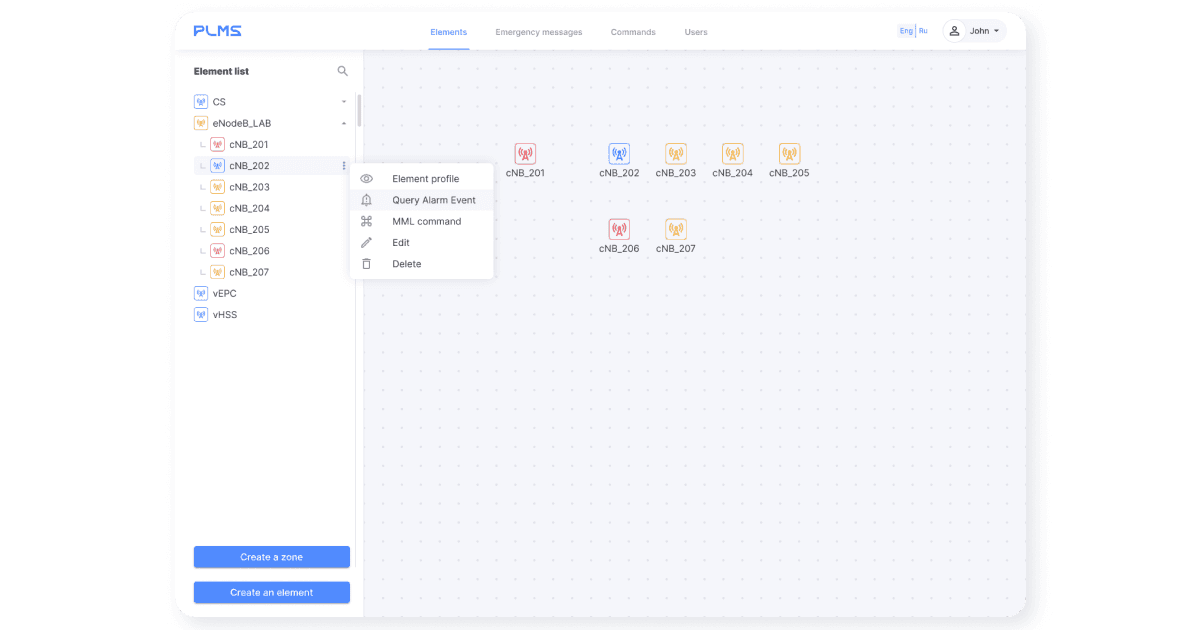
Private LTE Management Systems (PLMS) is a modern frontend application for monitoring and managing cellular network infrastructure.
The project was developed for a software company building products for telecom operators and infrastructure integrators. The client’s solutions are used for monitoring, controlling, and operating network elements of cellular base stations.
Delivery timeline:
- • UX/UI design — ~2 weeks
- • Phase I (frontend development without integration) — ~1.5 months
- • Phase II (backend integration and production readiness) — ~1 month
Status: deployed and used in production
About the Client
A software development company serving telecom operators and infrastructure integrators.
The client’s products are used for monitoring, controlling, and operating network elements of cellular base stations.
Primary system users:
- •Network monitoring operators
- •Operations engineers
- •System administrators
Business Challenge
The client had a functionally solid but outdated network element management system from a UX/UI perspective, which resulted in:
- High cognitive load for operators
- Slower response to critical incidents
- Limited scalability and product evolution
Project goals:
- Fully redesign the frontend application
- Improve usability and operator efficiency
- Preserve and enhance existing business logic
- Integrate with the existing backend without modifying it
- Prepare the product for future growth
Solution
We built a new modern SPA for managing base station network elements, completely redesigning the interface and UX without changing the server-side system.
The backend was provided by the client. Our team was responsible for:
Key Functionality
Access Management
- User authentication
- Role-based access model (administrators / monitoring operators)
- Account management
Network Topology
- Interactive visualization of network elements
- Hierarchical structure (types → elements)
- Current state and alarm display
- Search and navigation across elements
- Network element profiles
Alarm Management
- Unified alarm center
- Flexible filtering and combined sorting
- Visual severity and status indicators
- Alarm profile with history and comments
- Data export (XLS)
- Filter templates (personal and shared)
Command Console
- Command execution on network elements
- Selection from predefined commands
- Manual command input
- Real-time execution logs
Architecture & UX
- SPA application with clear layer separation (UI / state / API)
- REST API integration with the backend
- Multilingual support (RU / EN)
- Optimized for large operator screens (up to 4K)
- High data density without sacrificing readability
- Minimal, functional interface with a focus on visual statuses
Core Challenges & Solutions
Complex Telecom Domain
A large number of entities, statuses, alarms, and logs.
Solution: deep domain analysis, glossary alignment, and careful decomposition of screens and workflows.
Large Data Volumes and Tables
A real-time, high-load interface with heavy data density.
Solution: UI component optimization, thoughtful state management, and efficient handling of lists and filters.
Legacy Backend Integration
No ability to modify the server-side system.
Solution: flexible frontend architecture, strict adherence to the API contract, phased integration, and testing.
Project Team
On our side:
- •Technical Director
- •Business Analyst
- •Project Manager
- •UX/UI Designer
- •Frontend Developer
On the client side:
- •Product Owner
- •Backend Developers
Methodology: Agile / Scrum
Process: iterative development, regular demos, UX reviews, and integration testing.
Technology Stack
Frontend
Integration
Tools
Results
Completely redesigned frontend
For an enterprise telecom system
Improved user experience
For monitoring operators
Reduced cognitive load
When handling alarms and incidents
Faster response times
For operational incidents
Product ready for scaling
And further development
Stable production performance
Without backend changes
What We’re Proud Of
Want to discuss your project?
Get in touch, and we’ll show you how we can help bring your idea to life