Mobile EdTech App Development for English Vocabulary Learning
EducationA case study of a mobile app built around a push-first learning model: automated word delivery, a personalized vocabulary base, and a spaced repetition algorithm. Cross-platform architecture powered by React Native and Node.js.
Project Overview
EdTech / Mobile App / Language Learning • iOS and Android • Product Development
Project type: a mobile application for learning English vocabulary.
Format: iOS / Android (React Native) + Backend (Node.js).
Core feature: vocabulary learning through push notifications and spaced repetition.
Team scope: idea → analytics → product design → UI/UX → development → testing → release → ongoing improvement.
Product Idea
Push English is a mobile application designed to help users expand their English vocabulary.
Core concept: words come to the user automatically through push notifications throughout the day.
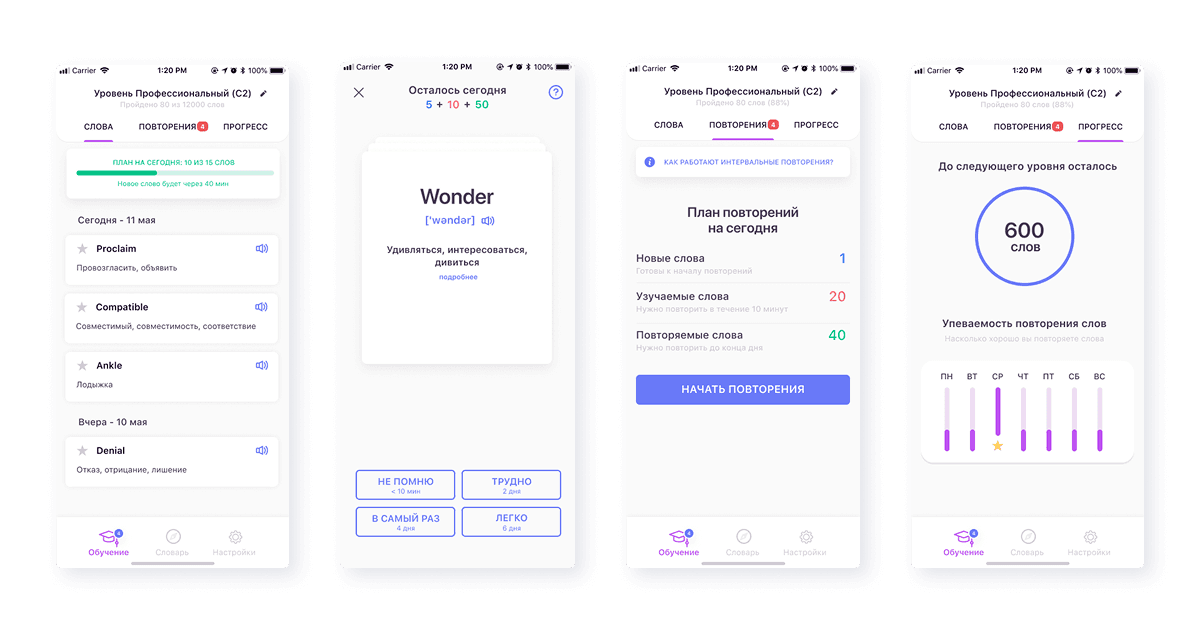
Instead of requiring users to set aside dedicated study time, the app delivers new words gradually during the day. Each push notification adds a word to the daily plan, which then builds a personalized vocabulary base.
We created the product as an internal EdTech initiative — from the initial hypothesis to a fully featured mobile application.
Business and Product Goal
Problem:
- •People struggle to learn new vocabulary consistently.
- •There is a need for a system that does not require a dedicated start time for each learning session.
- •Most learning apps depend heavily on user initiative.
Solution:
Build a mobile application that:
- automatically delivers new words through push notifications;
- builds a personalized vocabulary base;
- reinforces learning through spaced repetition;
- adapts to the user’s proficiency level.
Key Features
1. Push-Based Learning (Core Mechanic)
- Users configure the number of words per day, the delivery time window, their English level, and preferred topics.
- New words are delivered throughout the day via push notifications.
- After delivery, each word is automatically added to the daily plan.
- Daily plans gradually form the user’s personal vocabulary base.
Result: learning becomes part of everyday life.
2. Spaced Repetition
The second core mechanic is vocabulary reinforcement through spaced repetition.
- Review sessions are updated daily.
- Users see words from the previous day, poorly remembered words, and words that need reinforcement.
- The repetition algorithm takes answer accuracy into account.
This helps move vocabulary into long-term memory, reduces forgetting, and creates a structured learning progression.
3. Personalized Vocabulary Base
The vocabulary base is formed according to the user’s English level (A1–C1) and selected categories such as science, nature, travel, business, everyday vocabulary, idioms, phrasal verbs, and common expressions.
For each word, the app provides transcription, usage examples, audio pronunciation, and translation.
4. Flexible Learning Settings
Users can adjust the number of words per day, configure push schedules, choose vocabulary categories, and control repetition intensity.
Product Logic
The learning architecture is built around three levels:
- Push Notification → Daily Plan
- Daily Plans → Personal Vocabulary Base
- Vocabulary Base → Spaced Repetition
This creates a continuous cycle: Receive a Word → Add It to the Base → Review It → Reinforce It.
Development
The project was fully developed by our team:
- product analysis and learning methodology design;
- vocabulary database collection and structuring;
- UX/UI design;
- mobile development;
- backend architecture;
- push notification integration;
- testing;
- deployment and support.
This is an internal company product developed from scratch.
Technology Stack
Mobile
Backend
Notifications
Firebase Cloud MessagingChallenges
1. Balancing Push Frequency
Too many notifications become annoying. Too few reduce engagement.
Solution: flexible user settings and interval optimization.
2. Spaced Repetition Algorithm
The system needed to account for the date each word was introduced, memorization success, and error frequency.
Solution: server-side logic with daily recalculation of available reviews.
3. User Retention
A microlearning format requires carefully designed UX logic.
Solution: a minimalist interface, fast access to the daily plan, and short review sessions.
Result
- A working mobile application for iOS and Android
- A stable push-based learning system
- A personalized vocabulary base
- An implemented spaced repetition algorithm
- A scalable architecture ready for growth
What the Team Is Proud Of
- Thoughtful product design behind the learning flow
- A convenient and effective push-based learning system
- A flexible repetition architecture
- A fully developed internal EdTech product built from scratch
Summary
Push English is a strong example of how mobile technology, behavioral psychology, spaced repetition, and push-based engagement can be combined into a compact, intuitive, and scalable educational product.
Want to discuss your project?
Get in touch, and we’ll show you how we can help bring your idea to life