IoT Platform and Mobile App Development for a Smart Blood Pressure Monitor(NDA)
HealthcareHealthTech IoT case study: development of a mobile app for a medical device with Bluetooth and Wi-Fi integration, blood pressure analytics, and synchronization with Apple Health and Google Fit.
About the Project
HealthTech / Medical Devices / IoT • iOS, Android • Mobile Application
The client is an American manufacturer of smart medical devicesincluding blood pressure monitors, scales, thermometers, and pulse oximeters, building its own digital ecosystem to automate health metrics monitoring.
Our team delivered a full-cycle mobile application development service — from business analysis and architecture design to the first release and ongoing product evolution.
After one year of support and improvements, the project was fully handed over to the client’s in-house team.
Business Challenge
Build a cross-platform mobile app that extends the capabilities of a physical medical device and automates the collection of health metrics.
Project goals:
- Extend the functionality of the physical medical device
- Automate the collection and storage of health metrics
- Make the data clear, visual, and easy to analyze
- Integrate with Apple and Google health ecosystems
- Support future scaling for additional connected devices
Core Features
The application enables users to:
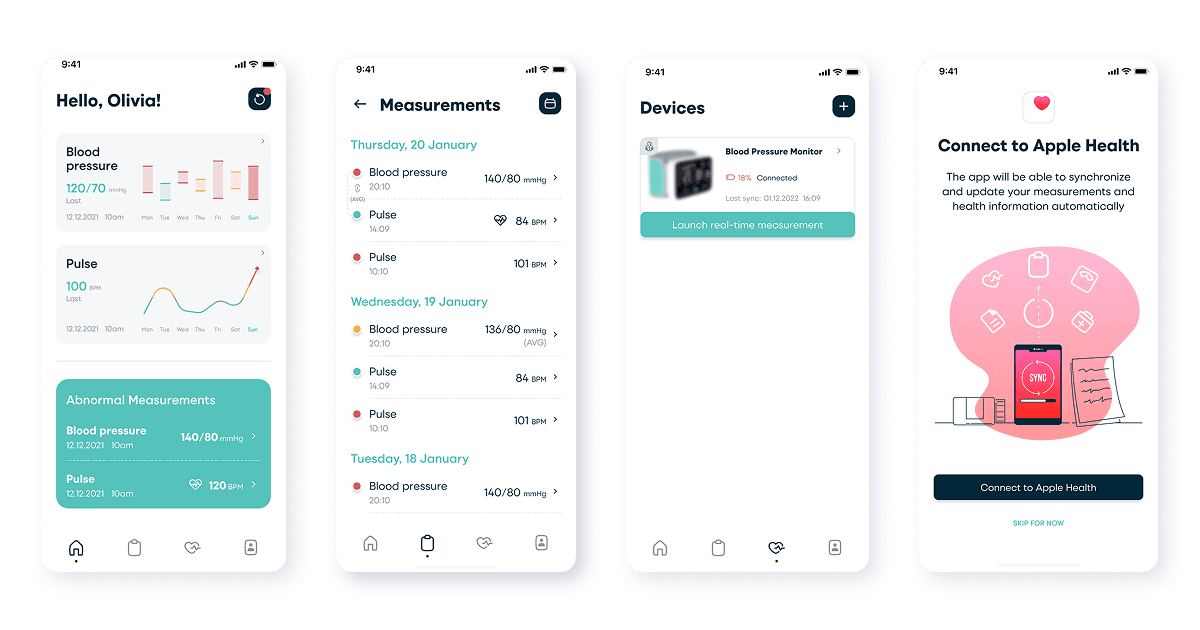
Connect to the smart blood pressure monitor via Bluetooth or Wi-Fi on iOS and Android
Automatically sync measurements with the server
Sign in through a unified user account
Save and review measurement history
Analyze data by day, week, and month
Visualize metrics with charts and graphs
Access device-related reference information
Sync data with Google Fit and Apple Health
Access health data from any device
Key Project Challenges
Reliable communication with the medical device
We needed to ensure a stable connection between the mobile application and the device via Bluetooth and Wi-Fi, accurate processing of measurement data, and protection against data loss during synchronization.
Clear visualization of medical data
Blood pressure readings had to be understandable not only for healthcare professionals but also for everyday users. To achieve this, we implemented charts with multiple analysis periods, color-coded deviation indicators, and a clear visual representation of changes over time.
Integration with health ecosystems
The application needed to become part of the user’s broader digital health environment, which required integration with Google Fit and Apple Health.
Scalability
The architecture was designed with future growth in mind: adding new types of medical devices, expanding the IoT product direction, and turning the application into a universal monitoring platform.
How We Delivered It
End-to-end product development
On the client side, the project involved a Product Manager. Our team fully covered business analysis, development, testing, and ongoing product growth.
2people IT project team:
- •Project Manager
- •Mobile Developer
- •Backend Developer (Node.js + TypeScript)
- •Frontend Developer (web admin panel)
- •UI/UX Designer
- •QA Engineer
Technology foundation
For the mobile application, we used React Native + TypeScript, which allowed us to build a unified app for iOS and Android, reduce development time, and improve code stability and maintainability.
The server side was implemented with Node.js + TypeScript, while PostgreSQL was used as the database, ensuring reliable storage and processing of health data.
Research and solution design
At the start of the project, we explored smart blood pressure monitor usage scenarios, reviewed competing solutions, designed user flows, and laid the architectural foundation for future product growth.
Bluetooth, Wi-Fi, and synchronization
We delivered seamless device integration: automatic connection via Bluetooth and Wi-Fi, real-time synchronization of measurements, device status display and last transmission time, and management of connected devices.
Analytics and visualization
The application includes interactive charts, time-based data grouping, visual zones highlighting deviations from the norm, and intuitive navigation through measurement history.
Google Fit and Apple Health integration
Once synchronization is enabled, data is automatically transferred to Google Fit and Apple Health, where it can be combined with other health indicators such as activity, sleep, heart rate, and more.
Administrative tools
For business-side product management, we developed a web-based admin panel that allows the client to manage devices, monitor user data, and administer the application’s digital ecosystem.
Results
Mobile app MVP delivered
In 4 months
Product support and evolution
For 1 year
Applications delivered
For iOS and Android
Stable device connectivity ensured
With Bluetooth and Wi-Fi devices
Health platform integration completed
With Google Fit and Apple Health
Architecture prepared
For future scaling
Project successfully handed over
To the client’s in-house team
Technology Stack
Frontend (Mobile)
Frontend (Web)
Backend
Database
Integrations
Summary
We developed a mobile application for smart medical devices as a full-fledged digital product — from research and architecture to a stable MVP and continued product evolution.
The project combined mobile development, IoT, medical data handling, and long-term product support.
Want to discuss your project?
Get in touch, and we’ll show you how we can help bring your idea to life