Development of a Gamified Telegram Mini App for a Web3 Project(NDA)
GamingA case study of building an MVP Telegram Mini App with server-side game logic, an upgrade system, leaderboards, and referral mechanics. The architecture was designed for scale and future Web3 tokenomics integration.
Overview
Gaming Services / Web3 / Digital Entertainment / Gamified Platforms • Telegram Mini App • MVP
Project Type
Telegram Mini App
Format
Gamified platform / casual game
Status
MVP
Development Timeline
~4 months
About the Project and Its Users
Region:
Europe
Core Users:
Telegram users engaged in gaming and Web3 ecosystems, interested in participating in future token-based products.
Business Goal
Build a Telegram Mini App that:
Development Goals
Solution
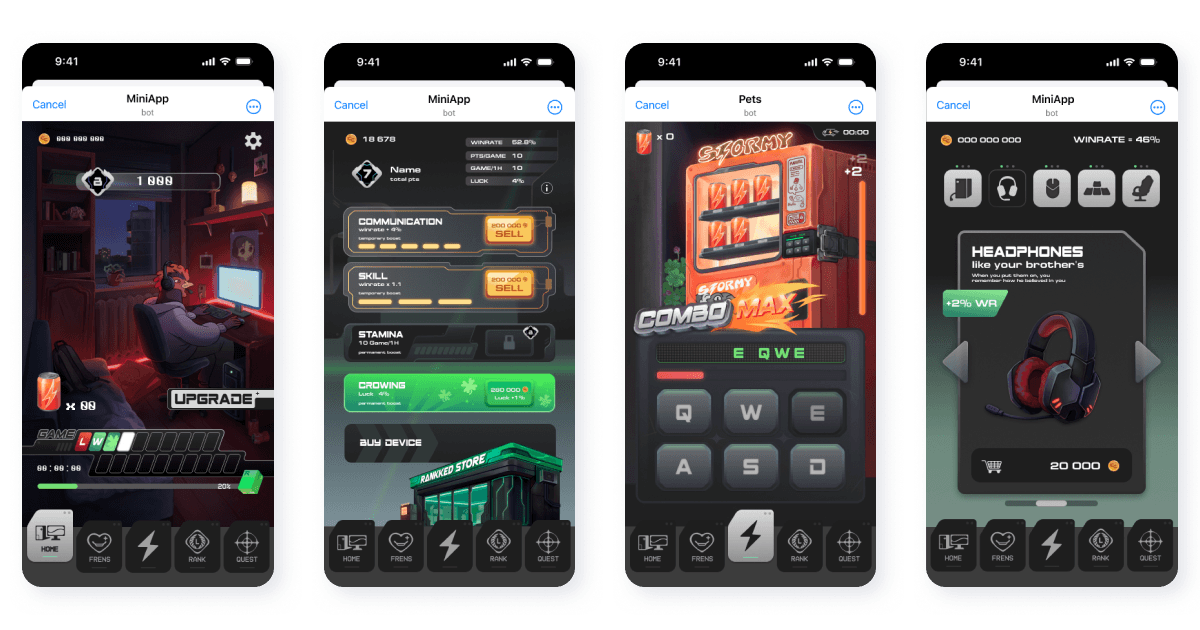
We built a Telegram Mini App in the format of a Web3-oriented tap game designed around competitive gameplay activity.
Users can:
- participate in gameplay loops and mini-games
- level up their character through an upgrade system
- earn points and in-game currency
- compete with other players on leaderboards
- invite friends through a gated referral system
The project was delivered end-to-end, from analytics and game-mechanic formalization to backend logic, frontend implementation, and infrastructure.
Core Game Mechanics
Currencies and Resources
- Points (PTS) — the main progression and leaderboard metric
- Coins — the in-game currency used for upgrades and actions
- Energy / Boosters — used to accelerate gameplay loops and activity
Gameplay Loops
- Gameplay loops built from 10–20 mini-games
- Loops are triggered automatically on a fixed schedule
- Multiple loops form a complete gameplay session
- Rewards are distributed through a claim mechanic
- Background session logic and progression checkpoints were implemented
Probabilities and Upgrades
- Win Rate — the probability of successfully completing mini-games
- Luck — the chance to turn a failure into a success
- All calculations and gameplay formulas were moved to the server
Main Features and Modules
Architecture and Technical Highlights
UX / UI
Project Challenges
The project involved several complex challenges:
How We Solved Them:
- Formalized gameplay states and dependencies during the analytics phase
- Moved calculations and validation checks to the server
- Implemented flexible mechanics configuration
- Tested gameplay edge cases extensively
- Iteratively synchronized frontend and backend development
Project Team
On the development side:
On the client side:
Methodology: Agile / Scrum — sprints, demos, and iterative refinement of game mechanics.
Results
A fully functional MVP Telegram Mini App
A working gamified platform
Foundation for a Web3 launch
Ready for tokenomics integration
Scalable product architecture
Prepared for new gameplay mechanics
Active user base
An engaged audience was built around the product
Technology Stack
Frontend
Backend
DevOps / Infrastructure
What the Team Is Proud Of
Summary
This project is a full-featured gamified platform built as a Telegram Mini App that successfully addresses user engagement, community building, and preparation for future Web3 expansion.
The implemented architecture and gameplay mechanics ensure stable platform performance and provide a solid foundation for scaling with new features and Web3 ecosystem integrations.
Want to discuss your project?
Get in touch, and we’ll show you how we can help bring your idea to life