AI Agents for Business: Use Cases, Benefits, and What Companies Should Know Before Implementation
Learn what AI agents are, how they differ from chatbots and AI assistants, where they create business value, and how to choose a first pilot.
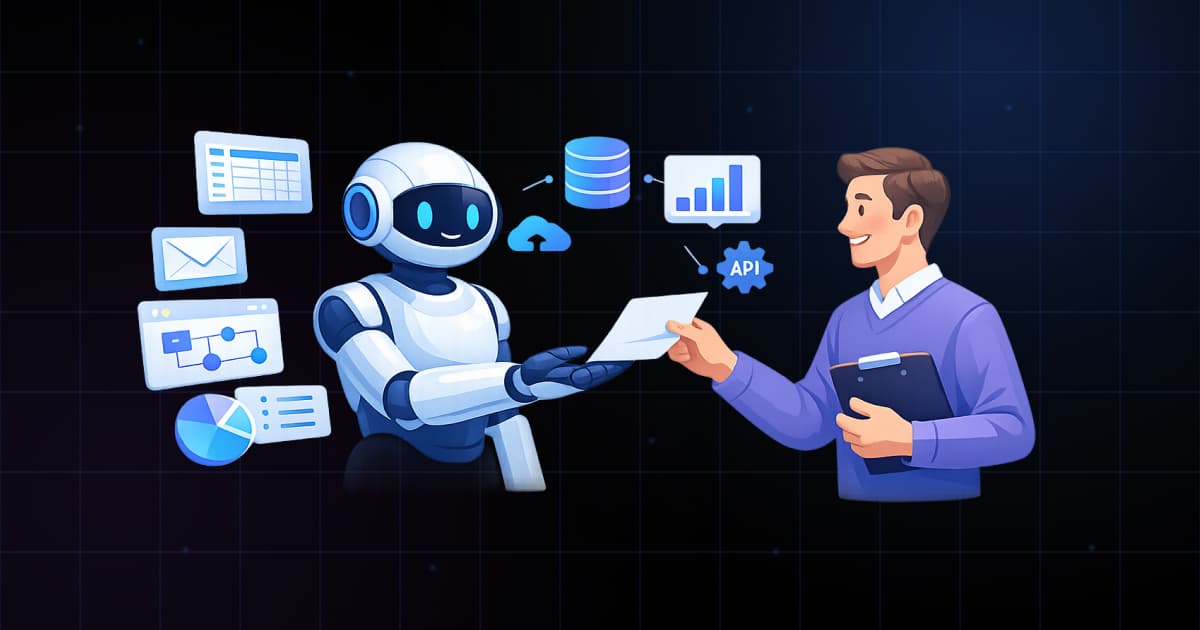
Artificial intelligence has already become part of real business operations. Companies use it in customer support, internal knowledge search, document processing, analytics, and routine automation. Against that backdrop, another term appears more and more often: AI agents. Yet for many business decision-makers, the concept still feels vague. Some see AI agents as simply more advanced chatbots, while others imagine them as almost fully autonomous digital employees.
In reality, the truth lies somewhere in between. AI agents are not a universal replacement for people, nor are they just another trendy label for AI software. They represent an approach in which a system can do more than answer a prompt: it can move through a sequence of steps within a task, analyze context, use data and tools, choose the next action, and help drive the work toward a result.
That matters because many business processes work exactly this way. A single answer is rarely enough. A system often needs to understand incoming information, find the right data, make an intermediate decision, pass the task along, or prepare an output for a team member. That is why AI agents are getting so much attention: they promise a more flexible form of automation that maps better to real operational workflows.
Why AI agents are getting so much attention
The growing interest in AI agents is easy to understand. Businesses have already seen how large language models can work with text: answering questions, summarizing documents, supporting employees, and extracting meaning from unstructured information. The next logical step is to use AI not only as an assistant, but as an active participant in a workflow.
That is exactly what makes the agent approach stand out. Instead of simply generating an answer, the system can receive a task, complete several intermediate actions, use connected data, and prepare an outcome. For example, it can do more than respond to a customer request: it can identify the request type, find the right information, draft a response, and pass the case to the right specialist.
At the same time, the market is full of noise. Some vendors call almost any AI bot an agent, while others reserve the term for more advanced systems with integrations, tool access, and multi-step logic. That is why businesses should focus less on the label and more on the actual role AI plays in the process: does it simply help with answers, or does it take part in getting work done?
What an AI agent is in simple terms
Without going too deep into technical detail, an AI agent is a system that can work toward a goal, make intermediate decisions, use data and tools, and complete several steps within a task with limited human involvement.
The key difference is that an agent is not limited to a prompt-and-response format. It can become part of a process. For example, it can receive an incoming request, identify the topic, find relevant information in a knowledge base or CRM, prepare an output, and pass it forward according to the right scenario.
It is important to understand that an AI agent is not just a chat interface. Chat can be a convenient way to interact with the system, but the essence of an agent is not dialogue — it is the ability to act within a task. That is especially valuable in business contexts where work consists of multiple steps, depends on context, and requires access to company data or systems.
At the same time, businesses should not think of an AI agent as a fully autonomous digital employee that can be trusted with any process without limits. In practice, these systems work best within a clearly defined workflow, with explicit boundaries, access to the right data, and human oversight where it matters.
How AI agents differ from chatbots and AI assistants
One of the main reasons the topic feels confusing is that chatbots, AI assistants, and AI agents are often treated as if they were the same category. In reality, even when they use similar underlying models, their role in the process is quite different.
A chatbot usually operates within a narrow scenario. It answers standard questions, helps with navigation, handles simple requests, and supports dialogue within a predefined or relatively limited logic.
An AI assistant helps a person work faster and more efficiently. It can find information, summarize documents, explain complex topics, prepare draft replies, and support employees with internal knowledge. It strengthens the person, but usually does not take over the process itself.
An AI agent goes one step further. It can do more than answer or assist: it can perform a sequence of actions, analyze a task, choose the next step, use tools and systems, and move the workflow toward an intermediate or final result.
In simple terms:
- a chatbot carries a conversation;
- an AI assistant helps a person;
- an AI agent participates in executing a workflow.
| Solution | Primary role | What it does | Best fit | Limitations |
|---|---|---|---|---|
| Chatbot | Handles dialogue within a defined scenario | Answers standard questions, supports navigation, and handles simple requests | FAQs, first-line communication, and typical customer questions | Not well suited for complex multi-step workflows or tasks that depend on context |
| AI assistant | Helps a person work more effectively | Finds information, summarizes documents, explains topics, and drafts responses or text | Internal knowledge, employee support, and day-to-day productivity | Usually does not take over the whole process or execute a chain of actions independently |
| AI agent | Participates in executing a workflow | Analyzes the task, chooses the next step, uses data and tools, interacts with systems, and drives the process toward a result | Multi-step workflows, request handling, support, document-heavy tasks, and integration-based scenarios | Requires clear boundaries, quality data, control, integrations, and a well-designed implementation scenario |
This distinction matters for business. Not every task requires an agent-based approach. In some cases, a chatbot is enough. In others, an assistant is the better fit. But when the goal is not just to answer, but to move through multiple steps and help complete the work, an AI agent becomes the more appropriate tool.
How AI agents work at a high level
At a high level, the logic is straightforward. The system receives a task, analyzes context, determines the next step, uses the required data or tools, and produces an outcome. Depending on the scenario, that outcome might be a prepared response, structured information, an updated record in a system, a created task, or a case handed off to an employee.
Incoming request
A customer message, request, document, or internal task
Context analysis
Identifies the topic, goal, and the right processing scenario
Data retrieval
Uses the knowledge base, CRM, documents, and other systems
Action or result preparation
Drafts a response, extracts data, creates a task, or updates a record
Handoff within the process
Passes the result to an employee or into the target system
The key value appears when the agent works not in isolation, but with real business data and systems. That can include a knowledge base, CRM, helpdesk, ERP, documents, internal directories, email, or other tools the company already uses. In that case, AI becomes more than a smart conversational layer — it becomes part of the operational environment.
For example, when handling an incoming request, the agent can identify the topic, find relevant information, check customer data, prepare a draft response, and decide whether the case should be passed to a human. In other words, it is not about a single good model response, but about a sequence of steps inside a real workflow.
That is why the agent approach is so interesting to businesses: it helps automate not just a single reply or action, but an actual segment of work.
Where AI agents create real business value
AI agents create the most value where a workflow consists of multiple steps, depends on context, and requires access to data or several systems.
One of the clearest examples is customer support. Here, an agent can classify incoming requests, set priority, find relevant information, prepare draft responses, and route cases to the right team. That reduces manual workload and speeds up handling time, especially when frontline teams spend a large share of their day on repetitive tasks.
Another strong use case is internal employee assistants. In many companies, employees spend a surprising amount of time searching through policies, instructions, documentation, and internal knowledge bases. An agent can do more than answer a question: it can suggest the next step, help employees navigate rules, and support a real process such as onboarding, approvals, or policy-related work.
Document processing is another important area. Applications, forms, contracts, invoices, and other documents often need to be read, structured, checked for completeness, and passed into downstream systems. Where employees previously reviewed documents manually and moved information across formats, an agent-based approach can reduce a significant amount of routine work.
AI agents also create practical value in lead qualification and inbound request handling. A system can analyze an incoming request, extract key parameters, determine which segment it belongs to, and route it to the right team or stage of the pipeline. That is especially useful in companies with a high volume of inbound requests where initial qualification directly affects sales speed and specialist workload.
Finally, some of the most interesting use cases appear where the agent works across multiple systems. In many organizations, employees still manually move information between a CRM, email, helpdesk, spreadsheets, ERP, and internal tools. If part of that work can be clearly described and bounded, an AI agent can reduce operational friction and eliminate repetitive manual steps.
Where simpler solutions are often enough
For all the excitement around the topic, it is important to stay realistic: businesses do not always need AI agents. In many cases, the problem can be solved more simply, more quickly, and at lower cost.
If the company only needs to answer standard customer questions, a regular chatbot may be enough. If the main need is better knowledge-base search and faster internal answers, a well-built AI assistant may solve the problem without agent logic. If a workflow is rigidly defined and requires little interpretation, traditional automation or a standard system integration will often be more reliable.
That matters because the agent approach makes sense where there is real multi-step logic, variability, and dependence on context. If those elements are missing, the added complexity may not be justified. The company may end up with a more expensive and more complicated solution where a simpler tool would have worked just fine.
A mature implementation mindset starts not with the question “How can we use agents?” but with “What type of solution best fits this specific task?”
What businesses need before implementation
Successful implementation depends on more than model quality. Even a strong model will not produce good results if the process is poorly defined, the data is fragmented, or the system’s boundaries are unclear.
Before launch, the company should define exactly which workflow the agent will operate in, where its scope starts and ends, which data it needs, and which decisions it may take independently. It is equally important to define what success looks like in business terms: faster handling time, less manual work, better response quality, fewer errors, or other measurable outcomes.
Access control, security, and oversight also matter. The closer an agent gets to real business systems, the more important it becomes to define permissions, guardrails, auditability, and points where a person remains in control. This is especially relevant if the system touches customer data, internal documents, or external communications.
In other words, implementing an AI agent is not just about plugging in a model. It is about designing logic, integrations, rules, constraints, and mechanisms of control — and that is what determines whether the solution succeeds in practice.
How to choose a first pilot use case
The best first scenario is not the most ambitious one — it is the most sensible one. Good pilot candidates are tasks that happen regularly, consume noticeable team time, produce a clear business effect, and do not carry an unacceptably high cost of error.
Strong first use cases often include support reply drafting, internal document and policy assistants, inbound request qualification, request routing, or structured data extraction from documents. These scenarios are practical, measurable, and make it easy to keep a human in the loop for review and decision-making.
On the other hand, broad end-to-end workflows, fully autonomous systems without oversight, and scenarios where mistakes are very costly are usually poor first choices. At the beginning, the goal is not to demonstrate the maximum possible capabilities of the technology — it is to get a clear result in a controlled segment of work.
That is how businesses usually unlock real value: they test the approach on one case, understand the limitations, measure the impact, and only then expand it to other workflows.
Common mistakes and risks
One of the most common mistakes is trying to automate too broad a workflow too early. The more vague the task, the harder it is to achieve a stable result — and the higher the chance of disappointment.
Another frequent issue is expecting full autonomy from day one. In practice, most successful implementations rely on clear constraints and human involvement at key points. That is not a weakness of the technology; it is a normal way to introduce it into real business operations without unnecessary risk.
Data quality is another major risk. If the underlying information is incomplete, inconsistent, or poorly structured, the agent will perform worse regardless of the model’s capabilities. Companies also often underestimate the complexity of integrations and ongoing operational support. A polished demo does not mean the solution will behave reliably in a live workflow every day.
That is why teams must design not only the smart layer itself, but also monitoring, error scenarios, handoff rules, and clear quality criteria. In practice, failures usually happen not because the technology fundamentally does not work, but because the use case was too complex, the boundaries were unclear, or expectations were unrealistic for the current stage.
Conclusion
AI agents are not just another trendy AI category. They represent a more advanced stage of automation in which a system can do more than answer prompts — it can participate in executing multi-step tasks. That is especially valuable in business workflows that involve context, data, several steps, and meaningful manual effort.
At the same time, the agent approach is not the right answer to every problem. In some situations, a chatbot is enough. In others, an AI assistant or traditional automation is the better choice. The key question for a company is not “Do we need AI agents at all?” but “Where will they create practical value for us?”
In most cases, the right path starts with one specific pilot: limited in scope, measurable, and easy to evaluate. That is how companies move beyond experimenting with the technology and start identifying where it truly creates value.

